Organization
Represents a collection of people organized together into a community or other social, commercial or political structure. The group has some common purpose or reason for existence which goes beyond the set of people belonging to it and can act as an Agent. Organizations are often decomposable into hierarchical structures. It is recommended that SKOS lexical labels should be used to label the Organization. In particular skos:prefLabel for the primary (possibly legally recognized name), skos:altLabel for alternative names (trading names, colloquial names) and skos:notation to denote a code from a code list. Alternative names: Collective Body Org Group
Diagram
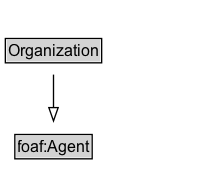
Specializations of Organization
| Class | Description |
|---|---|
| Business Entity1 | |
| Endeavour | A collaboration between two or more Organizations such as a project. It meets the criteria for being an Organization in that it has an identity and defining purpose independent of its particular members but is neither a formally recognized legal entity nor a sub-unit within some larger organization. Might typically have a shorter lifetime than the Organizations within it, but not necessarily. All members are org:Organizations rather than individuals and those Organizations can play particular roles within the venture. Alternative names: Project Venture Endeavour Consortium Endeavour |
| Formal Organization | An Organization which is recognized in the world at large, in particular in legal jurisdictions, with associated rights and responsibilities. Examples include a Corporation, Charity, Government or Church. Note that this is a super class of gr:BusinessEntity and it is recommended to use the GoodRelations vocabulary to denote Business classifications such as DUNS or NAICS. |
| Organizational Unit | An Organization such as a University Support Unit which is part of some larger FormalOrganization and only has full recognition within the context of that FormalOrganization, it is not a Legal Entity in its own right. Units can be large and complex containing other Units and even FormalOrganizations. Alternative names: OU Unit Department |
Formalization for Organization
| Property | Constraint |
|---|---|
| changedBy | only ChangeEvent |
| classification | only skos:Concept |
| hasMember | only foaf:Agent |
| hasPost | only Post |
| hasPrimarySite | only Site |
| hasSite | only Site |
| hasSubOrganization | only Organization |
| identifier | |
| linkedTo | only Organization |
| resultedFrom | only ChangeEvent |
| subOrganizationOf | only Organization |
| transitiveSubOrganizationOf | only Organization |
| disjointWith | Site |
| disjointWith | Role |
| subClassOf | foaf:Agent |
-
Specialization asserted by this ontology via alignment; the class is defined in an external ontology and is not declared as a specialization of this class there. ↩