Role
Represents additional information about a relationship or property. For example a Role can be used to say that a 'member' role linking some SportsTeam to a player occurred during a particular time period. Or that a Person's 'actor' role in a Movie was for some particular characterName. Such properties can be attached to a Role entity, which is then associated with the main entities using ordinary properties like 'member' or 'actor'.\n\nSee also blog post.
Diagram
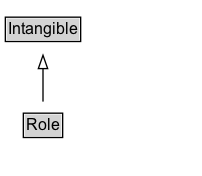
Specializations of Role
| Class | Description |
|---|---|
| Employee Role | A subclass of OrganizationRole used to describe employee relationships. |
| Link Role | A Role that represents a Web link, e.g. as expressed via the 'url' property. Its linkRelationship property can indicate URL-based and plain textual link types, e.g. those in IANA link registry or others such as 'amphtml'. This structure provides a placeholder where details from HTML's link element can be represented outside of HTML, e.g. in JSON-LD feeds. |
| Organization Role | A subclass of Role used to describe roles within organizations. |
| Performance Role | A PerformanceRole is a Role that some entity places with regard to a theatrical performance, e.g. in a Movie, TVSeries etc. |
Formalization for Role
| Property | Constraint |
|---|---|
| subClassOf | Intangible |